





News
ESC Oral Presentation and Publication in The Lancet! First Disclosure of Kylo-11 Phase I Clinical Study Data with Up to 48 Weeks of Follow-Up
Release Date: 2026-08-31

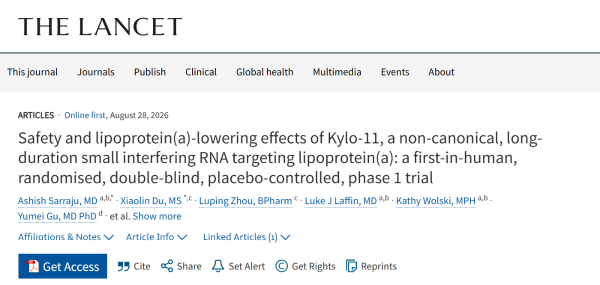
On August 28 (local time), the 2026 European Society of Cardiology (ESC) Annual Congress grandly opened in Munich, Germany. The final results of the Phase I clinical study of Kylo-11, an siRNA drug targeting lipoprotein (a) [Lp(a)] independently developed by Hygieia, a subsidiary of Sino Biopharmaceutical Limited (SBP Group, 1177.HK), were presented for the first time as a Late-Breaking Clinical Science (LBCT) oral presentation[1]. The full text of the study was simultaneously published in the top international medical journal The Lancet (IF: 109)[2].
Late-Breaking Clinical Science
Extremely Long Duration Lp(a) Reduction Following a Single Dose of Kylo-11: Final Data from a First-in-Human Study
Speaker: Ashish Sarraju, MD, Cleveland Clinic
This is the first full disclosure of the final follow-up data for up to 48 weeks, following the announcement of the preliminary Phase I study results for Kylo-11 at the 2025 American Heart Association (AHA) Scientific Sessions. The study was conducted at the Phase I Research Center of Xinhua Hospital in Chengdu, China, with Chinese and US research teams jointly promoting the publication of the research findings. Ashish Sarraju, MD, from the Cleveland Clinic and Xiaolin Du from Chengdu Xinhua Hospital are the co-first authors, and Professor Steven E. Nissen of the Cleveland Clinic is the corresponding author.
Maximum Reduction of 97.0% with a Single Dose, Significant Reduction Maintained for up to 48 Weeks
The Kylo-11 Phase I study was a randomized, double-blind, placebo-controlled, single ascending dose, first-in-human clinical study, in which a total of 70 subjects actually received Kylo-11 or placebo.
In the study, cohorts 1–6 enrolled subjects with baseline Lp(a) levels of 75–200 nmol/L, who received single subcutaneous injections of 9 mg, 30 mg, 75 mg, 225 mg, 450 mg and 600 mg of Kylo-11, respectively. Cohort 7 enrolled subjects with baseline Lp(a) levels of >200 nmol/L, who received a single subcutaneous injection of 225 mg of Kylo-11 to further evaluate the safety and Lp(a)-lowering effects of Kylo-11 in the population with high Lp(a) levels.
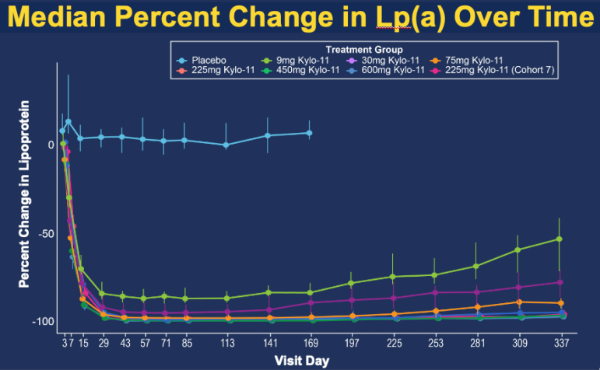
At Week 48, the median percentage change from baseline in Lp(a) in the medium- and high-dose groups
were 94.6% in the 225 mg dose group (cohort 4), 95.6% in the 225 mg dose group (cohort 7, the group
with a higher baseline), 96.3% in the 450 mg dose group (cohort 5) and 97.0% in the 600 mg dose group
(cohort 6). Among these, subjects in Cohort 7 had a median baseline Lp(a) level of 217.7 nmol/L. At 48 weeks after a single 225 mg dose, the absolute median reduction in Lp(a) from baseline was 207.7 nmol/L, and the median Lp(a) level decreased to 10.5 nmol/L.
Notably, in the 225 mg and higher dose groups, Lp(a) levels approached their maximum reduction approximately 4 weeks after dosing and remained at that level through week 48. The aforementioned results demonstrate that Kylo-11 has the potential to achieve a profound and durable reduction in Lp(a) following a single dose, thus providing important clinical evidence for further validation of the “once-a-year” dosing regimen in subsequent clinical studies.
Safety was the primary endpoint of the study. Within 24 weeks after dosing, 37 of the 70 subjects reported adverse events, primarily of Grade 1 or 2, the vast majority of which were judged by the investigator to be unrelated to the study drug. At the conclusion of the 48-week study, no clear trend of increasing adverse event incidence with increasing dose was observed. No serious adverse events, injection site reactions or deaths occurred during the study, nor were there any adverse events leading to interruption or discontinuation of the study drug or withdrawal of subjects from the study; Kylo-11 was generally well tolerated.
"Non-classical siRNA" Molecular Design, Exploring Ultra-Long-Acting Clinical Benefits
Kylo-11 is a long-acting siRNA drug that targets the LPA gene. By targeting LPA mRNA in the liver, it inhibits the synthesis of apolipoprotein(a), thereby reducing serum Lp(a) levels.
Unlike conventional GalNAc-siRNA structure, Kylo-11 employs a non-conventional siRNA molecular design, with two GalNAc moieties conjugated to the 3′ end of the sense strand and two additional GalNAc moieties conjugated to the 5′ end of the antisense strand. This unique structure may help enhance siRNA stability, improve hepatocyte uptake and extend the duration of therapeutic effect, while the specific mechanism remains to be further studied and validated.
The positive results from this Phase I study, showing that at doses of 225 mg and above, the significant reduction in Lp(a) after a single subcutaneous injection of Kylo-11 can be sustained for up to 48 weeks, provide a solid clinical basis for further clinical studies to explore an ultra-long-acting, once-yearly Lp(a)-targeting therapy.
A Phase II clinical study of Kylo-11 is currently underway in China and the United States in China and the United States in patients with atherosclerotic cardiovascular disease (ASCVD) and elevated Lp(a). The study aims to further evaluate the efficacy and safety of Kylo-11 in reducing Lp(a) levels in the ASCVD population, as well as to determine the appropriate dose and duration of therapeutic effect to support an annual dosing regimen.
Lp(a): The "Unchangeable by Exercise" Silent Cardiovascular Killer
Elevated Lp(a) level has been established as a significant causal risk factor for ASCVD and aortic valve stenosis, with approximately one-fifth of the global population having elevated Lp(a) levels. Unlike low density lipoprotein cholesterol (LDL-C), Lp(a) level is primarily determined by genetic factors and is generally difficult to significantly reduce with lifestyle interventions or traditional lipid-lowering therapies[3,4].
Currently, there are no regulator-approved drug therapies worldwide that specifically lower Lp(a) to reduce the risk of ASCVD events, leaving a significant unmet clinical need.
In recent years, nucleic acid drugs targeting Lp(a) have become a key direction in global cardiovascular drug development. How to achieve a sufficiently large, durable, and convenient reduction in Lp(a), and to further validate whether this reduction can translate into clinical cardiovascular benefits, are the core questions for the next phase of research in this field.
SBP Group will continue to advance the global clinical development of Kylo-11, collaborating closely with domestic and international research institutions and cardiovascular experts to accelerate the exploration of its clinical value in patients with elevated Lp(a) and high ASCVD risk, and provide breakthrough treatment options for patients worldwide.

Ashish Sarraju, MD, Cleveland Clinic, USA
Lp(a) is a lipoprotein biomarker that is highly influenced by genetic factors and is a well-established causal risk factor for cardiovascular disease. However, there has long been a lack of specific clinical interventions targeting Lp(a). For such cardiovascular risk factors that require long-term management, in addition to the magnitude of reduction, the durability of effect and convenience of administration are also of clinical value.
The final Phase I data for Kylo-11 showed that in the 225 mg and higher dose groups, a single dose achieved a median reduction in Lp(a) of up to 97%, which was sustained for up to 48 weeks. Together with good overall safety and tolerability, it demonstrates a trend for significant reduction and long-term durability.
We look forward to future international collaborations betweern our research team in the US and research teams throughout the world to foster the innovative development of therapies for the benefit of patients everywhere.
References:
[1] Sarraju A, et al. Extremely Long Duration Lp(a) Reduction Following a Single Dose of Kylo-11: Final Data from a First-in-Human Study. Oral presentation at ESC Congress 2026, Aug 28, 2026.
[2] Sarraju A, Du X, Zhou L, et al. Safety and lipoprotein(a)-lowering effects of Kylo-11, a non-canonical, long-duration small interfering RNA targeting lipoprotein(a): a first-in-human, randomised, double-blind, placebo-controlled, phase 1 trial. The Lancet. 2026.
[3] Nordestgaard BG, Langsted A. Lipoprotein(a) and cardiovascular disease. Lancet. 2024;404:1255–1264.
[4] Reyes-Soffer G, Ginsberg HN, Berglund L, et al. Lipoprotein(a): a genetically determined, causal, and prevalent risk factor for atherosclerotic cardiovascular disease: a scientific statement from the American Heart Association. Arterioscler Thromb Vasc Biol. 2022;42:e48–e60.
Declaration:
This press release is intended solely to facilitate the communication and exchange of pharmaceutical and medical information and is provided for reference by healthcare professionals only. It is not intended for advertising purposes.
The Company does not recommend any drug and/or indication.
The information contained in this press release is provided for reference only and does not, in any way, substitute for professional medical advice or constitute medical or treatment advice. For information regarding the diagnosis or treatment of any specific disease, please consult a physician or other qualified healthcare professional.
Forward-Looking Statements:
This press release contains certain forward-looking statements, including statements regarding the clinical development plans for Kylo-11, anticipated clinical benefits and advantages, commercialization prospects, the potential for clinical benefits to patients, and potential commercial opportunities. Words such as “anticipate,” “believe,” “continue,” “may,” “estimate,” “expect,” “aim,” “intend,” “plan,” “potential,” “project,” “forecast,” “should,” “will,” “propose,” and “would,” as well as similar expressions, are intended to identify forward-looking statements, although not all forward-looking statements contain these identifying words.
These forward-looking statements represent the Company’s current expectations or projections based on the data and information available to it as of the date of this press release. Such statements are subject to various uncertainties and risks, including those relating to policies, research and development, market conditions and regulatory matters, among others. Actual results may differ materially from those expressed or implied in the forward-looking statements.
Existing and prospective investors are advised to carefully consider the risks and uncertainties that may affect the Company and not to place undue reliance on the forward-looking statements contained in this press release. These statements speak only as of the date of this press release. Except as required by applicable law, the Company undertakes no obligation to update or revise any forward-looking statements contained herein, whether as a result of new information, future events or otherwise.