



News
AASLD 2026 | CTTQ's TQ-A3334 Achieves a 20.8% HBsAg Clearance Rate, Marking New Progress in Therapeutic Approaches to Chronic Hepatitis B
Release Date: 2026-11-09

On November 8, local time, at the 2026 Annual Meeting of the American Association for the Study of Liver Diseases (AASLD), the results of a Phase II clinical study on TQ-A3334 (a novel, highly selective oral TLR7 agonist), independently developed by Chia Tai Tianqing, a core enterprise of Sino Biopharmaceutical (01177.HK), were selected as a Late Breaking Abstract and presented as an oral presentation.
The study showed[1] that after 48 weeks of treatment with TQ-A3334 combined with nucleos(t)ide analogues (NAs), the high-dose group achieved a Hepatitis B surface antigen (HBsAg) seroclearance rate of 20.8% and a seroconversion rate of 16.7%, and showed more prominent efficacy in patients with low baseline HBsAg. This result provides further clinical evidence for exploring a functional cure for hepatitis B by activating the body's antiviral immune response.
Late Breaking Abstract Oral Presentation
Efficacy and Safety of TQ-A3334, an Oral TLR7 Agonist, in NAs-Treated Patients with Chronic HBV Infection Over 48 Weeks: A Double-Blind, Randomized, Placebo-Controlled Phase 2 Trial
Lead Investigators: Professor Peng Hu, The Second Affiliated Hospital of Chongqing Medical University, and Professor Hong Tang, West China Hospital of Sichuan University
Presenter: Professor Hong Tang, West China Hospital of Sichuan University
48-Week HBsAg Clearance Rate Reaches 20.8%, with Prominent Response in Low-Baseline Patients
This was a double-blind, randomized, placebo-controlled Phase 2 clinical study (NCT06706310) designed to evaluate the efficacy and safety of TQ-A3334 combined with NAs for treating patients with chronic HBV infection, including NA-treated and NA-naïve cohorts. The data presented here are from the NA-treated cohort. Patients enrolled were aged 18–65 years, with chronic HBV infection for at least 6 months, had been receiving NA treatment for at least 6 months and stable for at least 3 months, had HBsAg levels of 100–5000 IU/mL at screening, HBV DNA below the lower limit of detection, and no hepatic cirrhosis.
The NA-treated cohort had a total of 3 treatment groups, including: the low-dose group (0.2 mg TQ-A3334 tablets QD or placebo, combined with NAs), the medium-dose group (0.5 mg TQ-A3334 tablets QOD or placebo, combined with NAs), and the high-dose group (0.5 mg TQ-A3334 tablets QD or placebo, combined with NAs). In each group, patients were randomized to TQ-A3334 or placebo at a 3:1 ratio. After 48 weeks of treatment, TQ-A3334 tablets or placebo were discontinued, and patients continued with NA monotherapy for follow-up until week 72.
The primary endpoint was the change in HBsAg from baseline at week 24; secondary endpoints included the change in HBsAg from baseline at week 48, HBsAg seroclearance and seroconversion rates at weeks 24 and 48, as well as safety and tolerability. As of October 15, 2026, a total of 81 patients were enrolled in the NA-treated cohort, with 12, 24, and 24 patients in the low-, medium-, and high-dose groups, respectively, and 21 patients in the placebo group. Demographic and disease characteristics were generally balanced across the groups.
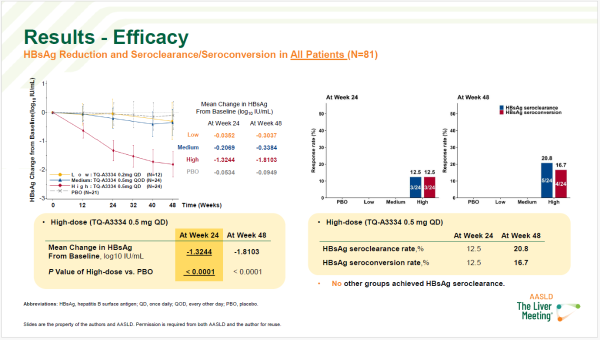
Clinical data showed: ● 1. Significant HBsAg decline, with further reduction following continued treatment: In the high-dose group, the mean HBsAg decline from baseline was 1.3244 log10 IU/mL and 1.8103 log10 IU/mL at weeks 24 and 48, respectively, both showing a statistically significant difference compared to placebo (both p<0.0001); no significant HBsAg decline was observed in the other dose groups. In the high-dose group, the proportion of patients with HBsAg <100 IU/mL reached 45.8% and 58.3% at weeks 24 and 48, respectively.
● 2. HBsAg seroclearance and seroconversion achieved in the high-dose group: At week 24, 3/24 patients in the high-dose group achieved HBsAg seroclearance and seroconversion, with rates of 12.5% for both; at week 48, 5/24 patients achieved HBsAg seroclearance (20.8%), and 4/24 patients achieved seroconversion (16.7%). No HBsAg seroclearance was observed in the other dose groups or the placebo group.
● 3. More prominent efficacy in patients with low baseline HBsAg: At week 48, in the subgroup with baseline HBsAg ≤1000 IU/mL, the mean HBsAg decline from baseline in the high-dose group was 2.0985 log10 IU/mL, and the HBsAg seroclearance and seroconversion rates were 26.3% (5/19) and 21.1% (4/19), respectively; in the subgroup with baseline HBsAg ≤500 IU/mL, the mean HBsAg decline from baseline in the high-dose group was 2.3211 log10 IU/mL, and the two rates were 40.0% (4/10) and 30.0% (3/10), respectively.
● 4. General manageable safety: In the high-dose group, the incidence rates of treatment-emergent adverse events (TEAEs) and treatment-related adverse events (TRAEs) were 100% and 91.67%, respectively. The incidence rates of Grade ≥3 TEAEs and TRAEs were 41.67% and 37.50%, respectively. No Grade 4 or 5 TRAEs occurred. The most common TRAEs were hematologic events, elevated ALT or AST, pyrexia, and headache; Grade 3 TRAEs were mainly hematologic events, all of which were reversible and manageable.
Multi-Mechanism Approach to an Innovative Treatment System, Exploring New Possibilities for a Hepatitis B Cure
Chronic HBV infection remains a major global health challenge. Current treatments mainly rely on NAs or interferon, but achieving a functional cure remains challenging due to persistent HBsAg expression and immune dysfunction.
TQ-A3334 is a novel, highly selective oral Toll-like receptor 7 (TLR7) agonist that activates innate and adaptive immune pathways and induces interferon and cytokine responses to reshape the body's anti-HBV immune response. It is an important exploration in the direction of a functional cure (clinical cure) for hepatitis B. The results of this study show that TQ-A3334 0.5 mg once daily combined with NAs can significantly reduce HBsAg levels in NA-treated patients and lead to HBsAg seroclearance and seroconversion in some patients, with more prominent efficacy shown in patients with low baseline HBsAg and a generally manageable safety profile.
Based on previous and current study results, TQ-A3334 was granted Breakthrough Therapy Designation (BTD) by the Center for Drug Evaluation (CDE) of the National Medical Products Administration of China in October 2026. These 48-week results provide further evidence for its subsequent clinical development, supporting TQ-A3334 as an oral immunomodulatory drug to offer a new potential treatment option for a functional cure of chronic HBV infection.
To achieve a functional cure for hepatitis B, the synergistic action of three major mechanisms is required: “inhibiting viral replication, reducing surface antigen (HBsAg), and rebuilding the immune response”. As one of the first pharmaceutical companies in China to focus on the field of liver diseases, Sino Biopharmaceutical is focused on the goal of a functional cure for hepatitis B. It has partnered with GSK to advance the launch of bepirovirsen in China, the world's first functional cure drug for hepatitis B, and is also developing Class 1 innovative drugs including TQ-A3334 (a TLR-7 agonist) and TQA3605 (an HBV capsid protein inhibitor), forming an innovative treatment system for chronic hepatitis B that covers different pathways such as HBV RNA targeted intervention, immune activation, and viral replication inhibition. This also provides more possibilities for exploring multi-mechanism combination therapy strategies in the future.
References:
[1] Peng Hu, Hong Tang, et al. Efficacy and Safety of TQ-A3334, an Oral TLR7 Agonist, in NAs-Treated Patients with Chronic HBV Infection Over 48 Weeks: A Double-Blind, Randomized, Placebo-Controlled Phase 2 Trial. AASLD 2026.
Disclaimer:
This press release is intended to facilitate the communication and exchange of medical information and is intended solely for healthcare professionals. It is not intended for advertising purposes.
The Company does not recommend any drug or indication.
The information contained in this press release is for reference only and is not intended to replace professional medical guidance in any way, nor should it be construed as medical advice or a recommendation for diagnosis or treatment. For information on the diagnosis and treatment of specific diseases, please follow the advice or guidance of a physician or other healthcare professional.
Forward-Looking Statements:
This press release contains certain forward-looking statements, including statements regarding TQ-A3334’s clinical development plans, anticipated clinical benefits and advantages, commercialization outlook, potential clinical benefits to patients, and potential commercial opportunities. Words such as “anticipate,” “believe,” “continue,” “may,” “estimate,” “expect,” “aim,” “intend,” “plan,” “potential,” “forecast,” “project,” “should,” “will,” and similar expressions are intended to identify forward-looking statements, although not all forward-looking statements contain these identifying words.
These forward-looking statements represent the Company’s current predictions or expectations based on the data and information currently available to it. Actual results may differ materially from those expressed or implied in these statements due to uncertainties and risks relating to policies, research and development, markets, regulatory matters, and other factors. Existing and prospective investors are advised to carefully consider the potential risks and not to place undue reliance on the forward-looking statements contained in this press release. Such statements speak only as of the date of this press release.
Except as required by law, the Company undertakes no obligation to update or revise any forward-looking statements in this press release as a result of new information, future events, or other circumstances.