



News
Major News! "Chinese Expert Consensus on the Diagnosis and Treatment of Chemotherapy-Induced Neutropenia (2026 Edition)" Released, Efbemalenograstim alfa Receives Authoritative Recommendation
Release Date: 2026-04-23
Chemotherapy is one of the core methods of tumor treatment, but chemotherapy-induced neutropenia (CIN) is the most common hematological adverse event in clinical practice. The resulting febrile neutropenia (FN) can lead to chemotherapy dose reduction, delays, and even endanger patient safety. On April 23, the "Chinese Expert Consensus on the Diagnosis and Treatment of Chemotherapy-Induced Neutropenia (2026)" was officially released. The new edition was revised based on the 2023 version, incorporating the latest evidence-based medicine to further standardize the entire process of CIN diagnosis and treatment. Among them, the Class 1 new drug Efbemalenograstim alfa from CTTQ, a core enterprise of Sino Biopharmaceutical Limited (SBP Group, 1177.HK), was included as a recommended drug for FN prevention[1]. This provides a more timely and targeted solution for the clinical prevention and treatment of CIN and safeguards the safety of chemotherapy for tumor patients.
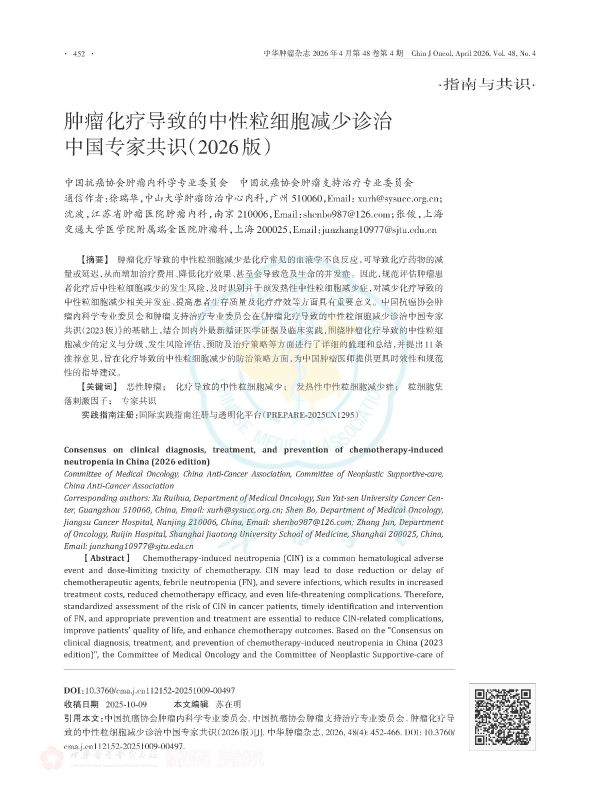
This consensus revision improves the standardized prevention and treatment system for CIN, clarifies the entire diagnosis and treatment pathway, and provides 11 graded core recommendations. It offers standardized and timely clinical guidance for enhancing chemotherapy tolerance and improving clinical outcomes for tumor patients:
· Content on clinical management principles for CIN, high- and low-risk chemotherapy regimens for FN, and patient-specific risk factors.
· Updated content on FN prevention in concurrent radiochemotherapy.
· Supplemented with granulocyte colony-stimulating factor (G-CSF) drugs marketed in China as of October 9, 2025, with Efbemalenograstim alfa explicitly included as a long-acting G-CSF.
· Added a section on non-G-CSF adjuvant drugs and patient education to complete the full-cycle CIN prevention and treatment system.
The "Chinese Expert Consensus on the Diagnosis and Treatment of Chemotherapy-Induced Neutropenia (2026)" systematically classifies G-CSF drugs, the core medication for CIN prevention and treatment. It clarifies the prophylactic application methods for different types of drugs and includes non-G-CSF drugs as adjuvant options. Efbemalenograstim alfa, as an important long-acting G-CSF, is recommended for use 24 hours after the end of chemotherapy for the prevention of FN. The benefits of its application in primary prevention and FN prevention related to concurrent radiochemotherapy are clear.
● Primary Prevention: Prophylactic use of G-CSF 24-72 hours after the first use of chemotherapy drugs with a risk of myelosuppression. The consensus points out that the results of a randomized controlled study of Efbemalenograstim alfa showed that the incidence of FN in the primary prevention group was significantly lower than in the non-prevention group (4.8% vs. 25.6%, P=0.0016), and the duration of Grade 4 CIN was significantly shorter (1.3d vs. 3.9d, P<0.0001)[2]
● Secondary Prevention: Assess the patient's risk of FN before the second and each subsequent chemotherapy cycle. If FN or a dose-limiting neutropenic event occurred in any previous cycle without prophylactic G-CSF use, prophylactic use of G-CSF may be considered during treatment with the same regimen. Considering patient compliance and pharmacoeconomic benefits, the use of long-acting G-CSF is recommended as a priority.
● FN Prevention in Concurrent Radiochemotherapy: For patients receiving high-risk chemotherapy regimens concurrently with radiotherapy, prophylactic use of G-CSF may be cautiously considered. The consensus cites the results of the Guard-01 study, where the Efbemalenograstim alfa primary prevention group was significantly superior to the non-prevention group (13.9% vs. 41.7%, P=0.0058)[3]
The release of the new consensus further provides standardized diagnosis and treatment criteria for CIN and FN caused by chemotherapy in clinical tumor patients. Efbemalenograstim alfa, recommended for its efficacy, safety, and convenient administration, will effectively help clinicians reduce the incidence of FN, ensure chemotherapy dose intensity, reduce therapy interruptions, and provide more stable bone marrow protection for patients undergoing high-risk chemotherapy and concurrent radiochemotherapy. In the future, SBP Groupwill continue to be guided by unmet clinical needs, relying on high-quality evidence-based medicine to help optimize the entire management process of CIN and improve treatment safety and survival benefits for tumor patients.
About Efbemalenograstim alfa
Efbemalenograstim alfa injection is the world's first approved third-generation dimeric G-CSF-Fc fusion protein. It uses an IgG2 Fc fragment to link two G-CSF molecules, which can extend the half-life of the functional protein G-CSF by mediating FcRn recycling. This achieves sustained release of neutrophils and reduces the cytotoxic effect on neutrophils when chemotherapy drug concentrations peak. It can be administered by subcutaneous injection 24 hours after the completion of anti-tumor drug administration in each chemotherapy cycle. It has the advantages of stably and persistently reducing the incidence of neutropenia (CIN) and a low incidence of adverse reactions such as bone pain and back pain. It has received a Level 1A recommendation for primary and secondary prevention of CIN caused by anti-tumor therapy in the "CSCO Guidelines for the Diagnosis, Prevention, and Treatment of Neutropenia Caused by Anti-tumor Therapy (2025)". Currently, it has been approved in China, the United States, and Europe, becoming an important force in global clinical oncology supportive care. After its launch, this product was included in the National Medical Insurance Directory, providing a more convenient and safer option for chemotherapy supportive care.
References:
[1] Medical Oncology Committee of the Chinese Anti-Cancer Association, Supportive Care Committee of the Chinese Anti-Cancer Association. Chinese expert consensus on the diagnosis and treatment of chemotherapy-induced neutropenia (2026)[J]. Chinese Journal of Oncology, 2026, 48(4): 1-15.
[2] Glaspy J, Bondarenko I, Burdaeva O, et al.Efbemalenograstim alfa, an Fc fusion protein, long-acting granulocyte-colony stimulating factor for reducing the risk of febrile neutropenia following chemotherapy: results of a phase Ⅲ trial[J].Support Care Cancer, 2023, 32(1):34.DOI:10.1007/s00520-023-08176-6.
[3] Chen Y, Li Q, Wen Z, et al.Abstract 4686: efficacy and safety of efbemalenograstim alfa as primary prophylaxis for concurrent chemo-radiotherapy induced neutropenia[J].Cancer Res, 2025, 85(Suppl 8_1):4686.DOI:10.1158/1538-7445.AM2025-4686
Declaration:
1. This press release is intended to facilitate the communication and exchange of medical information and is for reference by healthcare professionals only. It is not for advertising purposes.
2. The company does not recommend any drugs and/or indications.
3. The information contained in this press release is for reference only and cannot replace professional medical guidance in any way, nor should it be considered as a diagnosis or treatment recommendation. If you wish to understand specific disease diagnosis and treatment information, please follow the advice or guidance of a physician or other healthcare professional.
- Previous:Xu Xiao, First Secretary of the Secretariat of the Central Committee of the Communist Youth League, Leads Delegation to Inspect Chia Tai Tianqing, Focusing on Innovative Development and Youth Talent Cultivation
- Next:Leading the Next Generation of ADC Innovation! LaNova Medicines Showcases Two Differentiated Innovative Products at AACR 2026