





News
Domestic IDH1 Inhibitor Achieves New Breakthrough, Chia Tai Tianqing's TQB3454 Officially Included in Priority Review and Approval Process
Release Date: 2026-05-29
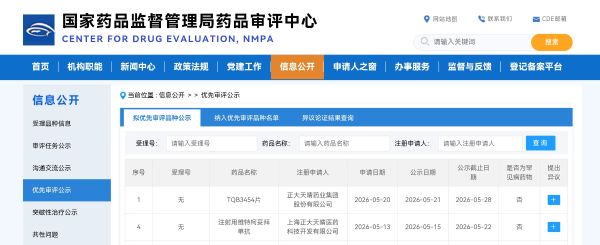
IDH1 inhibitors are an important component of precision therapy for biliary tract cancer, but currently, no drug targeting this pathway has been approved for the treatment of biliary tract cancer in China. On May 28, TQB3454, an IDH1 inhibitor independently developed by Chia Tai Tianqing, a core enterprise of Sino Biopharmaceutical Limited (SBP Group, 1177.HK), was officially included in the priority review and approval process. It is intended for the treatment of patients with locally advanced, recurrent, and/or metastatic biliary tract cancer with an IDH1 mutation who have failed treatment with gemcitabine and fluorouracil-based regimens. This is expected to accelerate the filling of the gap in this therapeutic area in China.
TQB3454 is a highly selective IDH1 inhibitor that specifically inhibits the mutant IDH1 enzyme, thereby reducing downstream 2-HG levels, improving the DNA and histone hypermethylation status caused by abnormally elevated 2-HG, restoring normal chromatin structure, and promoting the return of mutant cells to normal differentiation and development processes, thus achieving an anti-malignant tumor effect.
Chia Tai Tianqing announced in March 2026 that the Phase III clinical study (TQB3454-III-01) of TQB3454 in patients with advanced biliary tract cancer with an IDH1 mutation met its primary endpoint in a pre-specified interim analysis, with both progression-free survival (PFS) and overall survival (OS) reaching the pre-defined superiority boundaries of the protocol. The interim analysis results showed that compared to the control group, TQB3454 significantly reduced the risk of disease progression or death in patients with advanced biliary tract cancer, and significantly prolonged PFS and OS. The safety data were consistent with known risks, with no new safety signals identified.
This is the second in the world and the first in China successful Phase III clinical study of an IDH1 inhibitor in biliary tract cancer. TQB3454 is also the first domestically developed IDH1 inhibitor to complete a Phase III clinical study, and it is expected to fill the clinical gap in precision targeted therapy for IDH1-mutant biliary tract cancer in China. Related research data will be announced at an authoritative international academic conference to be held this year.
Biliary tract cancer is a type of digestive system malignant tumor with an insidious onset and rapid progression. It accounts for about 3% of digestive system malignant tumor, and due to its high invasiveness and poor prognosis, the 5-year survival rate is less than 5%. The incidence of biliary tract cancer is on the rise globally, with the highest rates in Asian countries, and the disease burden cannot be ignored. Among these, the incidence of IDH1 mutations in patients with intrahepatic cholangiocarcinoma is 13%-17%. However, there are currently no drugs targeting the IDH1 pathway approved for the treatment of biliary tract cancer in China, and there remains a significant unmet clinical need in this area.
TQB3454 was granted Breakthrough Therapy Designation by the CDE in April 2023. Its inclusion in the priority review and approval process marks a key milestone for the drug, moving it from the clinical research stage to the marketing application stage. Furthermore, TQB3454 has shown good clinical development potential in various solid tumors such as glioma and chondrosarcoma, and is expected to provide a new precision targeted therapy option for patients with IDH1 mutations.
Declaration:
1. This press release is intended to facilitate the communication and exchange of medical information and is for reference by healthcare professionals only. It is not for advertising purposes.
2. The company does not recommend any drugs and/or indications.
3. The information contained in this press release is for reference only and cannot replace professional medical guidance in any way, nor should it be considered as a diagnosis or treatment recommendation. If you wish to understand specific disease diagnosis and treatment information, please follow the advice or guidance of a physician or other healthcare professional.
Forward-Looking Statements:
This press release contains certain forward-looking statements, including statements regarding the clinical development plan, expected clinical benefits and advantages, commercialization outlook, potential for patient clinical benefit, and potential commercial opportunities for [TQB3454]. Words such as "expect", "believe", "continue", "may", "estimate", "hope", "intend", "plan", "potential", "predict", "project", "should", "will", "propose", and similar expressions are intended to identify forward-looking statements, but not all forward-looking statements contain these identifying words. These forward-looking statements are predictions or expectations made by the company based on currently available data and information, and actual results may differ materially from these forward-looking statements due to uncertainties or risks such as policy, R&D, market, and regulatory factors. Current or potential investors are advised to carefully consider the potential risks and should not place undue reliance on the forward-looking statements in this press release, which contain information only as of the date of this press release. Unless required by law, the company undertakes no obligation to update or revise any forward-looking statements in this press release as a result of new information, future events, or other circumstances.