





News
Chia Tai Tianqing and Shionogi's Major Collaboration, Naldemedine, Approved for Marketing in China
Release Date: 2026-05-29
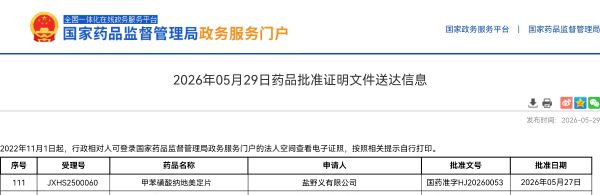
On May 29, the official website of the National Medical Products Administration (NMPA) showed that Naldemedine Tosilate tablets was approved for marketing for the treatment of opioid-induced constipation (OIC) in adults [1]. The approval of this innovative drug will provide a new treatment option to improve the quality of life (QOL) for patients suffering from OIC and will promote the overall level of supportive care in oncology in China. In January 2025, Chia Tai Tianqing, a core enterprise of Sino Biopharmaceutical Limited (SBP Group, 1177.HK), signed an agreement with Shionogi to obtain exclusive marketing rights for naldemedine in mainland China.
Naldemedine is the world's first approved oral, peripherally-acting mu-opioid receptor antagonist. It directly restores normal intestinal peristaltic rhythm and fluid secretion by blocking the binding of opiates to μ-receptors in the gut, thereby reversing the pathological process of OIC at its source [2]. Currently, naldemedine has been approved for marketing in China (including Hong Kong, Macau, and Taiwan), the United States, the European Union, the United Kingdom, and Japan. It is recommended for the treatment of OIC by the American Gastroenterological Association (AGA) and ESMO guidelines [3,4].
The incidence of pain in advanced cancer patients can reach 60%-80%, with about one-third of these patients experiencing moderate to severe pain. Opiates are one of the main methods for treating chronic pain in cancer patients, but 60%-90% of patients experience OIC symptoms [5], which seriously affects their quality of life and treatment adherence. How to effectively treat OIC while balancing analgesia and the occurrence of adverse reactions has become one of the urgent clinical problems to be solved.
Currently, laxatives commonly used in clinical practice to treat OIC may cause gastrointestinal adverse reactions such as nausea, vomiting, diarrhoea, and abdominal pain, and they only treat the symptoms, not the root cause. Although opioid receptor antagonists can alleviate constipation by weakening the gastrointestinal effects of opiates, they may also reduce the analgesic effect of opiates by crossing the blood-brain barrier [6]. Naldemedine selectively acts on intestinal μ-opioid receptors, has no risk of electrolyte disturbance, is suitable for the long-term medication needs of OIC patients, and barely enters the central nervous system, with no observed impact on the analgesic effect of opiates.
Chia Tai Tianqing will work with Shionogi to further deepen their strategic cooperation, steadily advance the marketing and promotion of naldemedine in mainland China, and strive to bring this innovative drug to more domestic OIC patients as soon as possible, helping to enhance the level of supportive care in oncology in China.
About Naldemedine
Naldemedine is an opioid receptor antagonist with binding affinity for mu (μ), delta (δ), and kappa (κ) opioid receptors. In tissues such as the gastrointestinal tract, naldemedine acts as a peripherally acting μ-opioid receptor antagonist, thereby reducing the constipating effect of opiates [1]. Naldemedine is a derivative of naltrexone. The introduction of a side chain increases its molecular weight and polar surface area, thereby reducing its ability to cross the blood-brain barrier (BBB). Naldemedine is also a substrate for the P-glycoprotein (P-gp) efflux transporter. Based on these properties, the central nervous system (CNS) penetration of naldemedine at recommended dose levels is expected to be negligible, thus reducing its potential to interfere with the central analgesic effects of opiates [1].
Multiple non-clinical and clinical studies have also shown that after oral administration, naldemedine can effectively treat OIC by antagonizing the effects of opiates on peripheral intestinal receptors, without reducing the analgesic effects mediated by opiates acting on CNS receptors.
References:
[1] Naldemedine Tosilate Tablets Package Insert (Approval Date: May 27, 2026)
[2] John M, Edward J, et al.Peripherally Acting u-Opioid Receptor Antagonists for theTreatment of Opioid-Related Side Effects: Mechanism of Action and Clinical Implica-tions.
[3] Seth D.Crockett, Katarina B.Greer, Joel J.Heidelbaugh,et al.American Gastroenterological Association Institute Guideline on the Medical Management of Opioid-Induced Constipation.Gastroenterology 2019;156:218–226.
[4] N.Katakami, T.Harada2, T.Murata,et al.Diagnosis, assessment and management of constipation in advanced cancer: ESMO Clinical Practice Guidelines.Annals of Oncology 29(Supplement4):iv111-iv125, 2018.
[5] Porta-Sales J, Nabal-Vicuna M, Vallano A, et al.Have we improved pain control in cancer patients?A multicen-ter study of ambulatory and hospitalized cancer patients[J].J Palliat Med, 2015,18(11):923-932.
[6] Wang Yue, Jiang Kui. Pathological Mechanisms and Treatment Progress of Opioid-Induced Constipation [J]. Chinese Journal of Clinical Oncology, 2021, 48(16):852-857.
Declaration:
1. This press release is intended to facilitate the communication and exchange of medical information and is for reference by healthcare professionals only. It is not for advertising purposes.
2. The company does not recommend any drugs and/or indications.
3. The information contained in this press release is for reference only and cannot replace professional medical guidance in any way, nor should it be considered as a diagnosis or treatment recommendation. If you wish to understand specific disease diagnosis and treatment information, please follow the advice or guidance of a physician or other healthcare professional.