





News
CTTQ's Marketing Applications for TQB2102 and TQH2722 Accepted for Review
Release Date: 2026-09-16
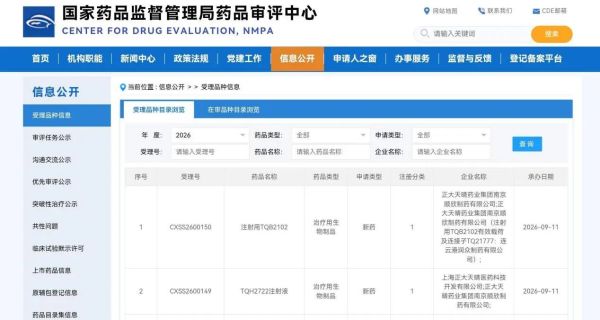
Recently, the marketing applications for two Class 1 therapeutic biologics developed by CTTQ (Chia Tai Tianqing), a core enterprise of Sino Biopharmaceutical Limited (SBP Group, 01177.HK) — TQB2102 for injection and TQH2722 injection — were accepted for review on the same day. They are indicated for adult patients with unresectable or metastatic HER2-low (IHC 1+ or IHC 2+/ISH-) breast cancer who have not previously received chemotherapy for recurrent or metastatic disease, and for the treatment of adult patients with moderate-to-severe atopic dermatitis (AD) who have inadequate response to or are not suitable for topical therapies, respectively.
TQB2102: Reshaping the Precision Treatment Landscape for HER2-Low Breast Cancer
TQB2102 is a HER2 bispecific antibody-drug conjugate (ADC) independently developed by CTTQ. The acceptance of its marketing application is based on the positive progress made in the Phase III clinical study of TQB2102 for the treatment of HER2-low recurrent/metastatic breast cancer. This is also the world's first successful Phase III clinical trial of a HER2 bispecific ADC in HER2-low breast cancer, achieving a breakthrough in precision treatment for this patient population. The indication has been granted Breakthrough Therapy Designation by the Center for Drug Evaluation (CDE) of the National Medical Products Administration.
TQB2102-III-01 is a randomized, open-label, active-controlled, multicenter Phase III clinical study that enrolled a total of 543 patients with HER2-low breast cancer. According to the previously announced interim analysis results, the study met its prespecified primary and key secondary endpoints as assessed by the Independent Data Monitoring Committee (IDMC). Compared to the investigator's choice of chemotherapy, TQB2102 significantly reduced the risk of disease progression or death, with the primary endpoint of progression-free survival (PFS) showing a statistically significant and clinically meaningful improvement. Detailed data from this study will be presented at upcoming international academic conferences.
The antibody component of TQB2102 features an asymmetric structural design, allowing it to simultaneously bind to two different domains of HER2, ECD II and ECD IV. This dual-epitope synergistic effect enhances binding and internalization efficiency into tumor cells. It also uses an enzyme-cleavable linker, which expands the killing range against heterogeneous tumors through a "bystander effect". TQB2102 has an optimized drug-to-antibody ratio (DAR) of approximately 5.8-6.0 and is equipped with a topoisomerase I inhibitor payload, enhancing anti-tumor activity while maintaining a favorable safety profile. This unique drug design overcomes the limitations of traditional HER2 monoclonal antibodies or single-target ADCs, offering greater potential advantages for the treatment of HER2-low tumors.
Currently, a clinical development system for TQB2102 is being established to cover different HER2 expression levels and multiple tumor types. This includes multiple directions such as HER2-low breast cancer, neoadjuvant therapy for HER2-positive breast cancer, first-line and later-line treatment for advanced HER2-positive breast cancer, and later-line treatment for HER2-positive biliary tract cancer and colorectal cancer. Among these, three indications have received Breakthrough Therapy Designation from the CDE, further demonstrating its application potential in the treatment of HER2-expressing solid tumors.
On August 31, SBP Group announced that it had entered into an exclusive licensing and supply agreement with Cipla Limited for TQB2102, covering 7 high-growth emerging market countries including India and South Africa, to accelerate the global reach of this domestically developed innovative ADC to patients worldwide.
TQH2722: Accelerating Expansion in the Treatment Landscape of Type 2 Inflammatory Diseases
TQH2722 injection is a fully human monoclonal antibody targeting interleukin-4 receptor alpha (IL-4Rα). By specifically binding to IL-4Rα, it simultaneously inhibits the activation of signaling pathways mediated by IL-4 and IL-13, thereby blocking the type 2 inflammation pathway upstream and reducing type 2 inflammation-related pathological reactions.
The indication submitted this time is for adult patients with moderate-to-severe atopic dermatitis (AD) who have inadequate response to or are not suitable for topical therapies. Atopic dermatitis is a chronic, recurrent, inflammatory skin disease. Patients with moderate-to-severe conditions often suffer long-term from multiple impacts including skin lesions, intense pruritus, and decreased sleep and quality of life. Epidemiological surveys show that approximately 15-20% of children worldwide have AD, with a prevalence rate of 6-10% in adults[1]. Precision biologic therapy targeting the core pathway of type 2 inflammation is becoming an important direction for the systemic treatment of moderate-to-severe patients.
TQH2722-III-01 is a multicenter, randomized, double-blind, placebo-controlled Phase III clinical trial of TQH2722 for the treatment of moderate-to-severe atopic dermatitis, which enrolled a total of 500 patients. The acceptance of this marketing application is based on the positive clinical results from this study. The co-primary endpoints, the EASI-75 response rate and the IGA 0/1 response rate at week 16, were both met. Multiple secondary endpoints also met their prespecified targets, with all efficacy indicators showing consistent and significant treatment benefits.
The results of the TQH2722-III-01 study showed that TQH2722 injection not only significantly improved patients" skin lesion status but also demonstrated outstanding efficacy in early pruritus improvement and quality of life improvement. At Week 52, all efficacy endpoints continued to show durable efficacy maintenance and clinical benefit. Furthermore, the safety and tolerability of TQH2722 with up to 52 weeks of administration were good, consistent with the safety observed at 16 weeks, with no new safety signals.
Focusing on type 2 inflammatory diseases, SBP Group has built a differentiated pipeline layout around key inflammation signaling pathways and upstream/downstream targets. This includes innovative drugs such as the oral STAT6 degrader TQH5528, the TSLP monoclonal antibody TQC2731, and the ST2 monoclonal antibody TQC2938, covering various type 2 inflammation-related diseases like asthma, atopic dermatitis, chronic sinusitis, and allergic rhinitis.
References:
[1] Yamamura K, Nakahara T. The Dawn of a New Era in Atopic Dermatitis Treatment. J Clin Med. 2022 Oct 18;11(20):6145.
Disclaimer:
This press release is intended to facilitate the communication and exchange of medical information and is intended solely for healthcare professionals. It is not intended for advertising purposes.
The Company does not recommend any drug or indication.
The information contained in this press release is for reference only and is not intended to replace professional medical guidance in any way, nor should it be construed as medical advice or a recommendation for diagnosis or treatment. For information on the diagnosis and treatment of specific diseases, please follow the advice or guidance of a physician or other healthcare professional.
- Previous:SBP Group and STADA Launch Strategic Biosimilars Partnership, Covering Key Markets in Europe and Eurasia
- Next:Theresa Tse Attends Shanghai International Pharma-Health Innovation and Capital Conference: AI Gives Wings to Innovation, Seizing the "Golden Moment" for Chinese Pharma to Go Global