





News
World's First Phase III Clinical Data for a HER2 Bispecific ADC Released! SBP Group's Innovative Breast Cancer Therapy TQB2102 Presented as an LBA at ESMO 2026
Release Date: 2026-10-23

On October 23 (local time), at the 2026 European Society for Medical Oncology (ESMO) Congress held in Madrid, Spain, TQB2102, a new-generation HER2 bispecific antibody-drug conjugate (ADC) independently developed by Chia Tai Tianqing, a core enterprise of Sino Biopharmaceutical Limited (SBP Group, 1177.HK), announced the latest data from the pivotal Phase III clinical study (APEX-Breast01) for the treatment of HER2-low advanced breast cancer.
The study was selected for Proffered Paper presentation as a Late-breaking Abstract (LBA) and was presented by Professor Shusen Wang from Sun Yat-sen University Cancer Center.
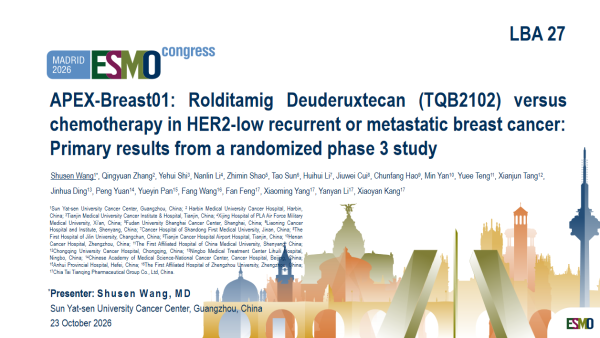
This is the world's first successful Phase III clinical study of a HER2 bispecific ADC in HER2-low breast cancer. The study results [1] showed that compared with investigator's choice of chemotherapy, TQB2102 significantly improved the median progression-free survival (mPFS) in patients with HER2-low recurrent or metastatic breast cancer (16.4 months vs. 5.5 months), reducing the risk of disease progression or death by 71%. The incidence of treatment-related interstitial lung disease (ILD) was only 2.2%, indicating clinically meaningful efficacy improvement and manageable safety.
Strongly Positive Phase III Results, Risk of Disease Progression Reduced by 71%
HER2-negative breast cancer accounts for about 80% of all breast cancer cases. Among these, HER2-low breast cancer (IHC 1+ or 2+/ISH−) represents nearly 60% and is predominantly seen in patients with HR-positive disease[2].
The APEX-Breast01 study is a multicenter, randomized, controlled Phase III clinical trial that enrolled patients with HER2-low recurrent/metastatic breast cancer who had not previously received chemotherapy for advanced disease, including HR-positive patients who had experienced disease progression after at least one line of endocrine therapy in the recurrent/metastatic setting. The primary endpoint was progression-free survival (PFS) in the HR+/HER2-low population, as assessed by a Blinded Independent Review Committee (BIRC). A key secondary endpoint was PFS in the overall HER2-low population.
As of May 31, 2026, a total of 543 patients had been randomized, including 461 HR-positive patients (over 90% had previously been treated with CDK4/6 inhibitors). Participants were randomized 1:1 to the TQB2102 arm (n=269) or the chemotherapy arm (n=274) to receive either TQB2102 7.5 mg/kg (intravenously every 3 weeks) or the investigator's choice of capecitabine, nab-paclitaxel, or paclitaxel. The primary endpoint and key secondary endpoints showed:
In the HR+/HER2-low population, the median PFS was 16.4 months in the TQB2102 arm versus 5.5 months in the chemotherapy arm (HR=0.29, 95% CI: 0.22-0.39; p<0.0001). In the overall HER2-low population, the median PFS in the TQB2102 arm also reached 16.4 months, significantly longer than 5.5 months in the chemotherapy arm (HR=0.29, 95% CI: 0.22-0.38; p<0.0001). In a study population with a high proportion of HR+ patients who had progressed after treatment with CDK4/6 inhibitors, TQB2102 delivered a significant PFS benefit, highlighting its clinical potential in patients with endocrine-resistant disease.
Objective Response Rate Reaches 68.8%, Grade 3 ILD Incidence Only 1.1%
In addition to progression-free survival, TQB2102 also achieved positive results in secondary efficacy endpoints such as tumor response and duration of response.
In the overall HER2-low population, the objective response rate (ORR) was 68.8% in the TQB2102 arm, higher than 31.0% in the chemotherapy arm. The median duration of response (DoR) was 15.0 (95% CI: 11.3, NE) months versus 7.1 (95% CI: 5.5, 9.8) months, and the clinical benefit rates (CBR) was 78.8% versus 44.2%, respectively.
In terms of overall survival (OS), TQB2102 showed a clear trend of OS benefit in both HR+ and the overall HER2-low populations. In HR-/HER2-low patients, TQB2102 demonstrated PFS and OS benefits consistent with those observed in the overall population.
The balance between efficacy and safety is a critical consideration in the clinical development of ADCs, with the risk of interstitial lung disease (ILD) being a key focus. The APEX-Breast01 study showed that the incidence of treatment-related ILD in the TQB2102 arm was 2.2%, with a Grade 3 ILD incidence of only 1.1%. No ILD-related deaths occurred. In terms of overall treatment tolerability, the proportion of patients who permanently discontinued treatment due to treatment-related adverse events was 1.5% in both the TQB2102 and the chemotherapy arms, indicating that the treatment was generally safe and tolerable.
These results indicate that while achieving significant PFS improvement and high tumor response, the overall safety risks of TQB2102 are controllable and manageable.
Focusing on breast cancer treatment, TQB2102 (a HER2 bispecific ADC) represents another first-in-class (FIC) innovative drug from SBP Group, following Culmerciclib Capsules (a CDK2/4/6 inhibitor). Breast cancer has also become, after lung cancer, another key therapeutic area in which SBP Group holds a leading position in China. Its product portfolio now covers the major molecular subtypes, including HR-positive/HER2-negative, HER2-low, and triple-negative breast cancer, and spans the full continuum of care, from neoadjuvant and adjuvant therapy to first-line, second-line, and later-line therapy in the advanced setting.
During ESMO 2026, Chia Tai Tianqing, a subsidiary of SBP Group, had 5 innovative products and 21 studies selected, covering 3 marketed innovative drugs: anlotinib, benmelstobart, and penpulimab, as well as 2 investigational products: TQB2102 (a HER2 bispecific ADC) and TQB2868 (a PD-1/TGF-β bifunctional fusion protein). Among them, TQB2102 secured 2 oral presentations, including 1 LBA Proffered Paper and 1 Rapid Oral presentation on the first-line treatment of gastric cancer.
More data interpretations will be released successively. Stay tuned!
About TQB2102
TQB2102 is a new-generation HER2 bispecific ADC with best-in-class (BIC) potential, independently developed by Chia Tai Tianqing. It can simultaneously target the ECD 2 and ECD 4 domains of HER2 and utilizes a cleavable linker and a topoisomerase I inhibitor payload. It can overcome the limitations of traditional HER2 monoclonal antibodies or single-target ADCs, further enhancing receptor cross-linking and internalization efficiency, expanding coverage of tumor heterogeneity, and overcoming single-target drug resistance.
TQB2102 is establishing a clinical development system covering different HER2 expression levels and multiple tumor types, including breast cancer, intestinal cancer, gastric cancer, lung cancer, biliary tract cancer, etc. Among these, three indications—HER2-low breast cancer, neoadjuvant therapy for HER2-positive breast cancer, and advanced colorectal cancer—have been granted Breakthrough Therapy Designation (BTD), highlighting its broad potential application in the treatment of HER2-expressing solid tumors.
Disclaimer:
This press release is intended to facilitate the communication and exchange of medical information and is intended solely for healthcare professionals. It is not intended for advertising purposes.
The Company does not recommend any drug or indication.
The information contained in this press release is for reference only and is not intended to replace professional medical guidance in any way, nor should it be construed as medical advice or a recommendation for diagnosis or treatment. For information on the diagnosis and treatment of specific diseases, please follow the advice or guidance of a physician or other healthcare professional.
Forward-Looking Statements:
This press release contains certain forward-looking statements, including statements regarding TQB2102’s clinical development plans, anticipated clinical benefits and advantages, commercialization outlook, potential clinical benefits to patients, and potential commercial opportunities. Words such as “anticipate,” “believe,” “continue,” “may,” “estimate,” “expect,” “aim,” “intend,” “plan,” “potential,” “forecast,” “project,” “should,” “will,” and similar expressions are intended to identify forward-looking statements, although not all forward-looking statements contain these identifying words.
These forward-looking statements represent the Company’s current predictions or expectations based on the data and information currently available to it. Actual results may differ materially from those expressed or implied in these statements due to uncertainties and risks relating to policies, research and development, markets, regulatory matters, and other factors. Existing and prospective investors are advised to carefully consider the potential risks and not to place undue reliance on the forward-looking statements contained in this press release. Such statements speak only as of the date of this press release.
Except as required by law, the Company undertakes no obligation to update or revise any forward-looking statements in this press release as a result of new information, future events, or other circumstances.