





News
SBP Group Unveils Data on Its HER2 Bispecific ADC in First-Line Gastric Cancer Treatment at ESMO 2026, with ORR up to 95.8%
Release Date: 2026-10-24

On October 23 (local time), at the 2026 European Society for Medical Oncology (ESMO) Congress, TQB2102, a new-generation HER2 bispecific antibody-drug conjugate (ADC) independently developed by Chia Tai Tianqing, a core enterprise of Sino Biopharmaceutical Limited (SBP Group, 1177.HK), released the results of a Phase II clinical study evaluating TQB2102 in combination with benmelstobart (TQB2450) ± capecitabine as first-line treatment for HER2-positive advanced gastric cancer/gastroesophageal junction cancer (GC/GEJC). This is the first Phase II clinical study to explore a HER2 bispecific ADC combination regimen in the first-line setting for gastric cancer. The findings were selected for a Rapid Oral presentation at the congress. The study was led by Academician Ruihua Xu from Sun Yat-sen University Cancer Center, and the presentation was delivered by Professor Miaozhen Qiu from his team.
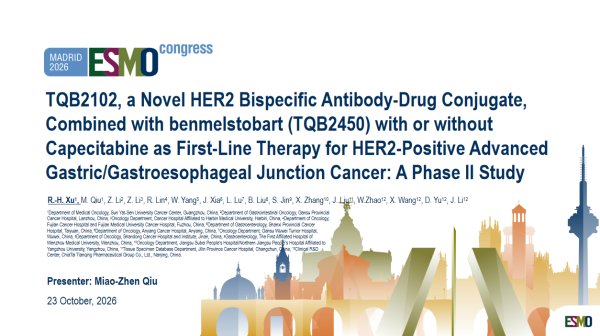
The study results [1] showed that the triplet regimen of TQB2102 combined with benmelstobart and capecitabine achieved an overall objective response rate (ORR) of 84.2%. In particular, the ORR reached 95.8% in the TQB2102 6 mg/kg dose group, with a disease control rate (DCR) of 100%. This regimen demonstrates promising anti-tumor activity with a manageable safety profile, providing new Phase II clinical evidence for the use of HER2 bispecific ADCs in the first-line treatment of advanced gastric cancer and helping define the recommended dose for subsequent Phase III studies.
Triplet Regimen Delivers 84.2% ORR; 6 mg/kg Cohort Reaches 95.8%
TQB2102-II-04 (NCT06767800) is an exploratory, multicenter Phase II clinical study that enrolled patients with HER2-positive, unresectable locally advanced or metastatic gastric cancer/gastroesophageal junction cancer (GC/GEJC) who had not previously received systemic therapy in the advanced-disease setting. The study aims to evaluate the efficacy and safety of TQB2102 in combination with benmelstobart, with or without capecitabine.
The study comprised three treatment cohorts: Cohort A received TQB2102 7.5 mg/kg plus benmelstobart; Cohort B received TQB2102 7.5 mg/kg plus benmelstobart and capecitabine; and Cohort C received TQB2102 6 mg/kg plus benmelstobart and capecitabine. The primary endpoint was objective response rate (ORR). As of September 3, 2026, a total of 86 patients had been enrolled, including 25 in the doublet arm (Cohort A) and 61 in the triplet arms (Cohorts B/C).
Efficacy data showed an ORR of 69.6% and a disease control rate (DCR) of 95.7% in the doublet arm (Cohort A). In the triplet arms (Cohorts B/C), the overall ORR was 84.2%, with a DCR of 100%.
Notably, in the TQB2102 6 mg/kg triplet cohort (Cohort C), the ORR reached 95.8% (23/24), and the confirmed objective response rate (cORR) reached 91.7%, indicating a high level of tumor response.
Regarding progression-free survival (PFS), the median PFS in the doublet arm (Cohort A) was 12.68 months (95% CI: 5.78-NR). The PFS data in the triplet arms (Cohorts B/C) were not yet mature, with a 6-month PFS rate of 79.9%. The 6-month PFS rates were 73.1% in the 7.5 mg/kg cohort (Cohort B) and 90.2% in the 6 mg/kg cohort (Cohort C), respectively.
In terms of safety, adverse events were generally manageable across cohorts. Common treatment-related adverse events were mainly hematological and gastrointestinal adverse events. Most events were Grade 1 or 2, and no new safety signals were identified. Based on the overall efficacy and safety results from all dose groups, TQB2102 6 mg/kg was selected as the recommended dose for the subsequent Phase III clinical study.
Dual Success at ESMO 2026, TQB2102's Multi-tumor Development Continues to Advance
At the ESMO Congress of this year, positive results were also reported from APEX-Breast01, a pivotal Phase III study of TQB2102 in patients with HER2-low recurrent or metastatic breast cancer. The study results [2] showed that compared with investigator's choice of chemotherapy, TQB2102 significantly improved the median progression-free survival (mPFS) in patients with HER2-low recurrent or metastatic breast cancer (16.4 months vs. 5.5 months). The objective response rate (ORR) was also higher than in the control group (68.8% vs. 31.0%). The incidence of treatment-related interstitial lung disease (ILD) was only 2.2%, indicating clinically meaningful efficacy improvement and manageable safety.
As a new-generation HER2 bispecific ADC independently developed by Chia Tai Tianqing, TQB2102 is establishing a clinical development system covering different HER2 expression levels and multiple tumor types. This includes multiple indications such as HER2-low breast cancer, neoadjuvant therapy for HER2-positive breast cancer, first-line and later-line treatment for advanced HER2-positive breast cancer, and later-line treatment for HER2-positive biliary tract cancer and colorectal cancer. Notably, three indications of TQB2102—HER2-low breast cancer, neoadjuvant therapy for HER2-positive breast cancer, and advanced colorectal cancer—have been granted Breakthrough Therapy Designation (BTD), further highlighting its potential application in the treatment of HER2-expressing solid tumors.
On August 31, SBP Group announced that it had entered into an exclusive licensing and supply agreement with Cipla Limited for TQB2102, covering 7 high-growth emerging market countries including India and South Africa, to accelerate the global reach of this domestically developed innovative ADC to patients worldwide. Chia Tai Tianqing will continue to advance the subsequent clinical development and international collaboration for TQB2102, aiming to bring more cutting-edge treatment options to patients worldwide as soon as possible.
About TQB2102
TQB2102 is a new-generation HER2 bispecific ADC with best-in-class (BIC) potential, independently developed by Chia Tai Tianqing. It can simultaneously target the ECD 2 and ECD 4 domains of HER2 and utilizes a cleavable linker and a topoisomerase I inhibitor payload. It can overcome the limitations of traditional HER2 monoclonal antibodies or single-target ADCs, further enhancing receptor cross-linking and internalization efficiency, expanding coverage of tumor heterogeneity, and overcoming single-target drug resistance.
References:
[1] Ruihua Xu, Miaozhen Qiu, et al. TQB2102, a Novel HER2 Bispecific Antibody-Drug Conjugate, Combined with benmelstobart (TQB2450) with or without Capecitabine as First-Line Therapy for HER2-Positive Advanced Gastric/Gastroesophageal Junction Cancer: A Phase II Study. 2026 ESMO 2876RO.
[2] Shusen Wang, et al. APEX-Breast01: TQB2102 versus chemotherapy in HER2-low recurrent or metastatic breast cancer (r/m BC) - Results from a randomized phase 3 study.2026 ESMO LBA27.
Disclaimer:
This press release is intended to facilitate the communication and exchange of medical information and is intended solely for healthcare professionals. It is not intended for advertising purposes.
The Company does not recommend any drug or indication.
The information contained in this press release is for reference only and is not intended to replace professional medical guidance in any way, nor should it be construed as medical advice or a recommendation for diagnosis or treatment. For information on the diagnosis and treatment of specific diseases, please follow the advice or guidance of a physician or other healthcare professional.
Forward-Looking Statements:
This press release contains certain forward-looking statements, including statements regarding TQB2102’s clinical development plans, anticipated clinical benefits and advantages, commercialization outlook, potential clinical benefits to patients, and potential commercial opportunities. Words such as “anticipate,” “believe,” “continue,” “may,” “estimate,” “expect,” “aim,” “intend,” “plan,” “potential,” “forecast,” “project,” “should,” “will,” and similar expressions are intended to identify forward-looking statements, although not all forward-looking statements contain these identifying words.
These forward-looking statements represent the Company’s current predictions or expectations based on the data and information currently available to it. Actual results may differ materially from those expressed or implied in these statements due to uncertainties and risks relating to policies, research and development, markets, regulatory matters, and other factors. Existing and prospective investors are advised to carefully consider the potential risks and not to place undue reliance on the forward-looking statements contained in this press release. Such statements speak only as of the date of this press release.
Except as required by law, the Company undertakes no obligation to update or revise any forward-looking statements in this press release as a result of new information, future events, or other circumstances.