





News
ORR Reaches 65.22%! SBP Group's TQB2868 Phase II Data for First-Line Treatment of Pancreatic Cancer Unveiled at ESMO 2026
Release Date: 2026-10-25

From October 23 to 27 (local time), the 2026 European Society for Medical Oncology (ESMO) Congress was held in Madrid, Spain. Studies on 2 investigational products and 3 marketed products from Chia Tai Tianqing, a core enterprise of Sino Biopharmaceutical Limited (SBP Group, 1177.HK), were selected for presentation. Among them, TQB2868, a PD-1/TGF-β bifunctional fusion protein, was presented in a poster, reporting results from a Phase II clinical study evaluating TQB2868 in combination with nab-paclitaxel/gemcitabine, with or without anlotinib, as first-line treatment for metastatic pancreatic ductal adenocarcinoma (mPDAC). The study was led by Professor Xianjun Yu from Fudan University Shanghai Cancer Center.
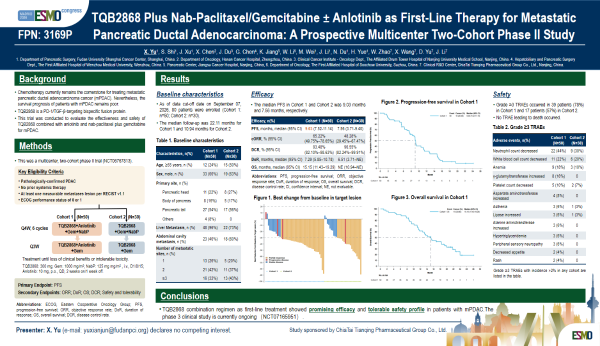
The study results [1] showed that the combination of TQB2868 with anlotinib plus chemotherapy achieved a confirmed objective response rate (cORR) of 65.22%, the median progression-free survival (mPFS) was 9.03 months, and the median overall survival (mOS) reached 15.15 months. The study demonstrated promising anti-tumor activity in the first-line treatment of metastatic pancreatic cancer, providing further clinical evidence for the dual-pathway immunotherapy strategy targeting PD-1/TGF-β. A Phase III clinical study is currently ongoing.
Dual-Pathway Targeting of Immunosuppression: Exploring First-Line Combination Treatment for Pancreatic Cancer
Pancreatic ductal adenocarcinoma (PDAC) has a complex tumor microenvironment (TME). Factors such as immunosuppressive cells and a dense stroma limit the infiltration and function of immune cells, which is a key reason for the limited efficacy of conventional immune checkpoint inhibitors in this patient population.
TQB2868 is designed as a PD-1/TGF-β bifunctional fusion protein. By blocking the PD-1 signaling pathway, it relieves the inhibition of T-cell activity; meanwhile, by neutralizing TGF-β in the TME, it delivers dual effects of immune checkpoint inhibition and TME remodeling to enhance the anti-tumor immune response.
Building on this mechanism, the study further combined TQB2868 with chemotherapy and the anti-angiogenic drug anlotinib to explore the clinical value of a multi-mechanism combination regimen in metastatic pancreatic ductal adenocarcinoma (mPDAC).
This study is a multicenter Phase II clinical trial that enrolled patients with metastatic pancreatic ductal adenocarcinoma (mPDAC) who had not previously received systemic therapy. The study included two cohorts: Cohort 1 received TQB2868 combined with anlotinib plus nab-paclitaxel/gemcitabine chemotherapy; Cohort 2 received TQB2868 combined with nab-paclitaxel/gemcitabine chemotherapy. The primary endpoint was investigator-assessed median PFS.
Confirmed ORR Reaches 65.22%, R&D Progress is Globally Leading
As of September 7, 2026, a total of 80 patients had been enrolled, including 50 in Cohort 1 and 30 in Cohort 2. The median follow-up durations were 22.11 months and 10.94 months, respectively.
The study data showed: In Cohort 1, the confirmed objective response rate (cORR) was 65.22%, the disease control rate (DCR) was 93.48%, the median PFS was 9.03 (95% CI: 7.52-11.14) months, the median OS reached 15.15 (95% CI: 11.43-19.29) months, and the median duration of response (DoR) was 7.29 months; in Cohort 2, the cORR was 48.28%, the DCR was 96.55%, the median PFS was 7.56 (95% CI: 3.71-9.40) months, the median OS was not reached, and the median DoR was 6.51 months.
In terms of safety, the incidence of Grade ≥3 treatment-related adverse events (TRAEs) was 78% in Cohort 1 and 57% in Cohort 2, respectively, mainly including neutrophil count decreased, white blood cell count decreased, and anaemia. No deaths due to TRAEs occurred, and no new safety signals were observed in the anlotinib combination cohort.
Overall, both combination regimens showed promising anti-tumor activity in the first-line treatment of mPDAC. A Phase III clinical study of TQB2868 for the first-line treatment of mPDAC is currently ongoing. As the PD-1/TGF-β bifunctional fusion protein with the fastest development progress globally, TQB2868 will be further evaluated to confirm the efficacy and safety of this combination strategy.
About TQB2868
TQB2868 is a PD-1/TGF-β bifunctional fusion protein independently developed by Chia Tai Tianqing, a subsidiary of Sino Biopharmaceutical Limited (SBP Group, 1177.HK). It blocks the PD-1/PD-L1 pathway and neutralize TGF-β in the tumor microenvironment, thereby combining immune checkpoint inhibition with tumor microenvironment remodeling. Dual inhibition of PD-1 and TGF-β signaling can deliver a more effective anti-tumor immune response than inhibiting either pathway alone, thereby improving anti-tumor clinical benefits.
Disclaimer:
This press release is intended to facilitate the communication and exchange of medical information and is intended solely for healthcare professionals. It is not intended for advertising purposes.
The Company does not recommend any drug or indication.
The information contained in this press release is for reference only and is not intended to replace professional medical guidance in any way, nor should it be construed as medical advice or a recommendation for diagnosis or treatment. For information on the diagnosis and treatment of specific diseases, please follow the advice or guidance of a physician or other healthcare professional.
Forward-Looking Statements:
This press release contains certain forward-looking statements, including statements regarding TQB2868’s clinical development plans, anticipated clinical benefits and advantages, commercialization outlook, potential clinical benefits to patients, and potential commercial opportunities. Words such as “anticipate,” “believe,” “continue,” “may,” “estimate,” “expect,” “aim,” “intend,” “plan,” “potential,” “forecast,” “project,” “should,” “will,” and similar expressions are intended to identify forward-looking statements, although not all forward-looking statements contain these identifying words.
These forward-looking statements represent the Company’s current predictions or expectations based on the data and information currently available to it. Actual results may differ materially from those expressed or implied in these statements due to uncertainties and risks relating to policies, research and development, markets, regulatory matters, and other factors. Existing and prospective investors are advised to carefully consider the potential risks and not to place undue reliance on the forward-looking statements contained in this press release. Such statements speak only as of the date of this press release.
Except as required by law, the Company undertakes no obligation to update or revise any forward-looking statements in this press release as a result of new information, future events, or other circumstances.