





News
SBP Group's CLDN18.2 ADC Marketing Application Accepted! Granted Multiple Breakthrough Therapy and Orphan Drug Designations
Release Date: 2026-06-24
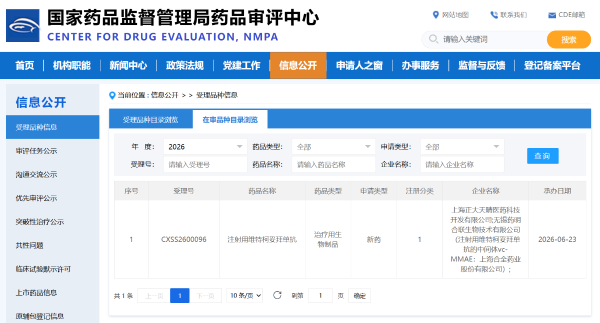
On June 23, the website of the Center for Drug Evaluation (CDE), National Medical Products Administration, showed that the New Drug Application for the CLDN18.2 ADC, Tecotabart Vedotin for Injection (LM-302), independently developed by LaNova Medicines, a core enterprise of Sino Biopharmaceutical Limited (SBP Group, 1177.HK), has been accepted. It is indicated for patients with CLDN18.2-positive, locally advanced or metastatic gastric or gastroesophageal junction adenocarcinoma who have received at least two prior lines of systemic therapy. On May 22, this indication was included in the priority review and approval procedure.
LM-302 is an antibody-drug conjugate (ADC) targeting CLDN18.2, formed by conjugating a recombinant humanized monoclonal antibody with the small molecule toxin MMAE. LM-302 can not only accurately identify CLDN18.2-positive tumor cells, but its MMAE payload also has a "bystander effect", which can further kill surrounding tumor cells with low or heterogeneous expression. In addition, LM-302 can induce immunogenic cell death (ICD). When combined with a PD-1 monoclonal antibody, it can produce a synergistic anti-tumor effect, providing an important mechanistic basis for "ADC + immunotherapy" combination therapy.
Currently, LM-302 is undergoing two pivotal registrational clinical studies in China: (1) as a monotherapy for third-line and above treatment of CLDN18.2-positive locally advanced or metastatic gastric or gastroesophageal junction adenocarcinoma. The study has completed enrollment of all participants, and LM-302 is the first CLDN18.2 ADC worldwide to complete enrollment in a Phase III registrational clinical trial; (2) in combination with a PD-1 monoclonal antibody for the first-line treatment of CLDN18.2-positive locally advanced or metastatic gastric or gastroesophageal junction adenocarcinoma. Both indications have been included in the Breakthrough Therapy Designation program by the CDE and have received three Orphan Drug Designations (ODD) from the US Food and Drug Administration (FDA), covering three tumor types with high unmet clinical needs: gastric cancer, pancreatic carcinoma, and biliary tract cancer.
Gastric cancer is one of the malignant tumors with high incidence and mortality rates worldwide. Global cancer burden statistics from 2022 show that there are 970,000 new cases of gastric cancer annually worldwide, with over 1/3 of the patients coming from China. For patients with advanced gastric cancer, treatment options that can extend survival are extremely limited, especially for patients who have experienced treatment failure. Their prognosis is generally poor, with a median overall survival (OS) of even less than 10 months [1], urgently requiring the exploration of new effective treatment options. CLDN18.2 is the second popular target after HER2 to have its druggability validated in the field of gastric cancer treatment, with moderate to high expression in 31%-86% of gastric or gastroesophageal junction adenocarcinomas.
The acceptance of the marketing application for LM-302 is based on the positive results obtained in the Phase III pivotal clinical study of LM-302 monotherapy for the third-line and above treatment of CLDN18.2-positive locally advanced or metastatic gastric or gastroesophageal junction adenocarcinoma. This study has completed its interim analysis and met both study endpoints. The relevant study data will be announced at an international academic conference in early 2027.
References:
[1]Wilke H,Muro K,Van Cutsem E,et al.Ramucirumab plus paclitaxel versus placebo plus paclitaxel in patients with previously treated advanced gastric or gastro-oesophageal junction adenocarcinoma(RAINBOW):a double-blind,randomised phase 3 trial.Lancet Oncol.2014Oct;15(11):1224-35.
- Previous:Faster Drugs, Better Access? Eric Tse Attends Summer Davos, Improving the Global Medication System with Technological Innovation and Open Cooperation
- Next:Summer Davos Spotlight | World Economic Forum Publishes Article by Eric Tse: How China's AI-driven Collaborations Are Reshaping Global Pharma